
Views: 0 Author: Site Editor Publish Time: 2026-09-18 Origin: Site


Seating capacity for a pedestal dining table depends on tabletop shape and size, not just the number of chairs you own. Round tables 42-48 inches wide typically seat 4 people, while rectangular tables 72-96 inches long seat 6-8. The table base also matters — a sturdy, single-pedestal design (like a powder coating table base) supports larger tabletops without extra legs crowding seated guests.
Choosing a dining table is one of those decisions that looks simple until you're standing in a showroom, staring at three different pedestal styles and wondering if your family of five will actually fit around any of them comfortably. Seating capacity isn't just about counting chairs — it's about matching the tabletop's dimensions, shape, and base construction to how you actually use the space.
This guide breaks down how to calculate seating capacity for a pedestal dining table, why the base construction matters more than most buyers realize, and what to look for if you're sourcing tables at scale for a restaurant, café, or furniture line.
A pedestal table swaps traditional four-leg construction for a single central column or a compact multi-leg base. This design gives seated guests more legroom, which is why pedestal tables are popular for both homes and hospitality venues.
Generally, seating capacity comes down to how much edge space each person needs. Furniture designers typically allow 24 inches of table edge per seated guest, plus corner allowances for rectangular and square tables. Here's how that translates across common table shapes and sizes:
Table Shape |
Table Size |
Typical Seating Capacity |
|---|---|---|
Round |
36-40 inches diameter |
2-4 people |
Round |
44-48 inches diameter |
4-6 people |
Round |
54-60 inches diameter |
6-8 people |
Square |
36-42 inches |
4 people |
Square |
48-54 inches |
8 people |
Rectangular |
60-72 inches long |
4-6 people |
Rectangular |
78-96 inches long |
6-8 people |
Rectangular |
108+ inches long |
8-10 people |
Round and square pedestal tables generally work best with a single central column, since the weight distributes evenly. Rectangular and oval tables over 72 inches often need a double-pedestal or trestle-style base for stability, since one column at the center can leave the ends of the tabletop feeling unsupported.
Beyond raw dimensions, shape affects how many people can comfortably sit down — and how they interact once they're there.
Round tables encourage conversation and work well in smaller dining rooms or breakfast nooks, since there are no corners eating into legroom. They're also a strong choice for coffee table bases, where guests are seated at odd angles around a lower surface.
Rectangular tables suit larger households or dining rooms and make it easy to add a bench or extra chair at the ends when unexpected guests arrive.
Square tables work well for smaller square rooms but become impractical above 54 inches per side, since reaching across the middle gets difficult.
If you're outfitting an outdoor patio, a garden table base needs to account for a few extra factors: wind resistance, drainage, and weather-resistant coatings, since these tables see far more environmental stress than an indoor dining table base.
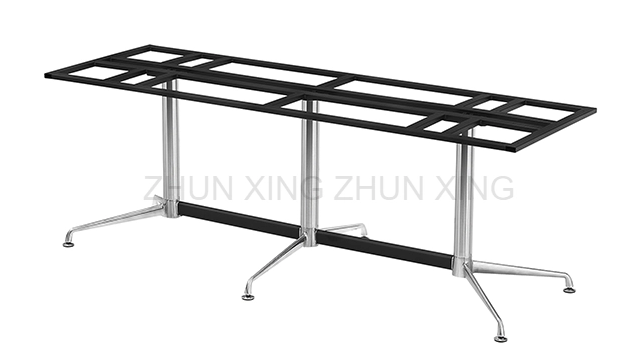
It's easy to focus entirely on the tabletop when planning seating, but the base underneath does most of the structural work. A poorly designed base can undercut even a well-sized tabletop.
Here's what to check:
Base footprint. A base that's too narrow relative to the tabletop creates tipping risk once people lean on the edges — a common issue with larger round or rectangular tops.
Legroom clearance. Multi-leg bases can crowd knees, especially at corners. Single-pedestal or double-pedestal designs free up space for more seated guests per linear foot of table edge.
Load capacity. Bases built for eight-person tables need to support significantly more weight than a two-seat café table, both from the tabletop material and from guests leaning or resting elbows on the surface.
For manufacturers and furniture brands sourcing components, this is where base selection becomes a design decision as much as an engineering one.
A powder coating table base is metal — typically steel or aluminum — finished with an electrostatically applied powder that's then cured under heat. Compared to standard painted finishes, powder coating creates a harder, more even surface that resists chipping, scratching, and corrosion.
For dining and hospitality furniture, this matters for a few practical reasons:
Durability under daily use. Restaurant and café tables get bumped, dragged, and cleaned constantly. A powder-coated dining table base holds up to that wear far better than liquid-painted alternatives.
Consistent color across large orders. Furniture brands producing tables at scale need finish consistency across every base. Powder coating delivers a uniform look batch after batch.
Indoor and outdoor versatility. The same finishing process used for a dining table base also works for a coffee table base or garden table base, since powder coating resists UV fading and moisture better than most alternatives.
This versatility is part of why powder-coated bases show up across so many table categories — dining, coffee, bar, and outdoor patio furniture all benefit from the same finishing process.
If you're sourcing table bases for a furniture line, restaurant chain, or hospitality project, the manufacturer you choose affects both product quality and how confidently you can promise seating capacity to your own customers. A few things worth confirming before placing an order:
Customization options. Can the manufacturer adjust base height, footprint, and finish color to match your tabletop specifications?
Material choice. Aluminum bases tend to be lighter and more corrosion-resistant, while steel bases typically offer greater load capacity for larger tabletops.
Production capability. For bulk orders, ask about lead times and minimum order quantities upfront.
ZhunXing, a manufacturer of aluminum and steel table and chair bases, produces powder-coated dining, coffee, and outdoor table bases designed for exactly this kind of sourcing need, offering customizable sizing for rectangular, round, and pedestal-style tables built for both indoor and outdoor use.
Matching seating capacity to a pedestal dining table comes down to three things: the tabletop's shape and size, the base's footprint and load capacity, and how the finish holds up to daily use. Get those three right, and the table will serve your space — and your guests — for years rather than months.
If you're planning a dining room refresh, start by measuring your space and working backward from the seating count you need. If you're sourcing components for a furniture line or hospitality project, reach out to a table base manufacturer directly to discuss customization options before committing to a design.
How many people can sit at a 60-inch round pedestal table?
A 60-inch round table typically seats 6-8 people comfortably, assuming each guest has roughly 24 inches of table edge.
Is a pedestal base sturdy enough for a large dining table?
Yes, provided the base footprint and design match the tabletop size. Tables over 72 inches often need a double-pedestal or trestle base rather than a single column for adequate support.
What's the difference between a dining table base and a coffee table base?
A dining table base is built to standard table height (28-30 inches) and support heavier daily use, while a coffee table base sits lower (16-18 inches) and generally supports lighter loads.
Can a powder-coated table base be used outdoors?
Yes. Powder coating resists moisture, UV exposure, and corrosion, making it a common choice for garden and patio table bases as well as indoor dining tables.
How do I know if I need a custom table base size?
If your tabletop dimensions fall outside standard sizing (for example, an oversized rectangular table or a non-standard round diameter), a custom base ensures proper support and stability. Most manufacturers, including ZhunXing, offer customized sizing for these cases.


